Forked River
Mountain
Views |
Newsletter of the Forked
River Mountain Coalition |
www.frmc.org |
Vol. 6 No.2 |
|
***Just A Reminder***
Forked River Mountain Cleanup
Where: Wells Mills County Park
Route 532
Waretown, NJ
When: Sunday, April 18, 1999
Arrive Between
8:30 am to 9:00 am
Return Between
12:30 pm to 1:00 pm
*Optional Hike Afterwards*
For more information or to register
call (609) 971-1635 or sign up here |
Annual Meeting Set
A special Thank you to the dozens of individuals who recently
joined or renewed their membership with the Coalition. This support will enable the
Coalition to continue our grass-roots initiative so we can all realize our goals of
preserving the Forked River Mountains and the vast wilderness that surrounds them.
Members of the Coalition will be able to participate in the fifth Annual
Meeting and election of members to the Board of Trustees. The Annual Meeting is scheduled
for May 31, 1999 at 9:30 a.m. at Double Trouble State Park. If you are a member of the
Coalition, you will receive a written notice of the election about a month before the
Annual Meeting.
If you are not currently a member of the Coalition but would like to
join, or if you are a member and have not yet renewed your membership, simply complete the
membership form. Be sure to mark the appropriate box and
return the form along with your $15 membership dues for 1999.
 Botanical Bounty . . .
Swamp Pink (Helonias bullata)
Swamp pink has smooth, evergreen, lance-shaped leaves that lie fairly
flat on the ground in a basal rosette. The leaves are shiny green when young and often
attain a purplish tint as the plant matures. The stocky, hollow flower stem grows from 1
to 3 feet tall and has sparse modified leaves along its length. In April or early May the
stem is topped by a cluster of pink flowers dotted with pale blue anthers. By late May the
stem dies back and turns light brown in color. The dried flowers release their seeds by
mid-June. Even when the plant is not in flower, the evergreen leaves of swamp pink can be
identified year-round. In fact, the plant may be easier to detect in the winter months
since few other herbaceous plants are still green. Although sometimes occurring as
individual plants, swamp pink is more often found in clumps. The prevalence of clumping is
likely the result of new plant growth from rootstocks and the limited distance that
dispersing seeds travel.
As the name implies, swamp pink is a wetland plant. Since the species
cannot survive in open sun, the plant is limited to forested wetlands dominated by
Atlantic white-cedar and red maple. Swamp pink often grows on hummocks formed by trees,
shrubs, and sphagnum moss. The hummocks keep the roots moist but not submerged in the
standing water and hydric soil characteristic of the plant’s habitat. Swamp pink are
found in wetlands that are perennially wet with the water table at or near the surface and
only slight fluctuations in water levels throughout the year. Once found inhabiting
wetland areas from New York to Georgia, swamp pink is now only found along the coastal
plain from New Jersey to Virginia and in small isolated bog areas in the Southern
Appalachian Mountains. New Jersey represents the global stronghold for the endangered
swamp pink, containing more than 70 percent of the know sites.
Clearing, draining and filing forested wetlands can quickly destroy
swamp pink and its habitat. Collecting, trampling and competition from non-native plants
also pose threats to the continued existence of swamp pink in its native habitat. A more
subtle assault on the survival of swamp pink includes gradual degradation of forested
wetlands. Biologists suspect that many extant and seemingly vigorous swamp pink
populations are in the process of a slow decline due to the impact of upland development
surrounding swamp pink populations. The long-term existence of swamp pink is dependent on
the availability of high-quality, undisturbed habitat. Such habitat exists in the Forked
River Mountain area. With your continued support we can preserve habitat for the swamp
pink and other rare and endangered plant (and animal) species.
Join Us in the Great Outdoors. . .
Here are three exciting opportunities to learn more about the Forked
River Mountains and view the areas unique flora and fauna. . .
 Barnegat Bay Festival Barnegat Bay Festival
The third annual Barnegat Bay Festival will be
held on Saturday, May 15, 1999. The festival is a cooperative effort of non-profit
organizations and government agencies dedicated to maintaining the health and quality of
the Barnegat Bay and its vast watershed covering most of Ocean County. The festival is
designed to heighten environmental awareness about the natural resources of the watershed
and the impact of human activities on these resources. Nearly two dozen activities are
being planned.
The Forked River Mountain Coalition and the New
Jersey Conservation Foundation, will present a program entitled: Exploring the Forked
River Mountain Reserve. The program will begin with a slide presentation about the Forked
River Mountains and this vast Pinelands wilderness. Afterward we will hike into the forest
to explore a pristine Pinelands stream and an Atlantic white cedar swamp.
Open space conservation in the Pinelands compliments
efforts to protect Barnegat Bay because many of the streams and rivers that flow into the
bay originate in the Pinelands. The Forked River Mountain area contains the headwaters to
three major tributaries of Barnegat Bay, including the Cedar Creek, Forked River and
Oyster Creek.
There is a limit of 20 persons for our
program so pre-registration is necessary. For additional information call (732)506-5313.
* Some illustrations from A Field Guide to
the Pine Barrens of New Jersey, by Howard Boyd, Plexus
Publishing, Inc. Medford, NJ |
 Canoe Trip Canoe Trip
The Forked River Mountain Coalition will
sponsor our fifth annual canoe trip down Cedar Creek on May 31, 1999. We will depart
Double Trouble State Park at 10:00 am and return approximately 3:00 pm. The cost is $5 per
person. There is a three (3) person limit per canoe.
Bring lunch, drink, insect repellant, sun
tan lotion, hat or sun glasses. Long pants and sneakers are recommended. No alcohol.
We will provide canoes, life
preservers and transportation back to Double Trouble State Park.
Persons who are interested in attending should
complete and return the registration form or call
(609) 971-1635 for more information.
Treefrog Hike
If you would like to try your luck at discovering
an endangered Pine Barrens Treefrog join us on the evening of Friday June 4, 1999. We will
meet at the Bamber Village Store at 7:30 pm and return around 9:30 pm. The Bamber Store is
located at the intersection of Lacey Road and Dover Road about 5 ½ miles west of Parkway
exit 74.
There will also be an opportunity to view
several unique plants during the hike including sundews, pitcher plants and the endangered
curly-grass fern.
The cost for this program is only
$5 per person. You must provide your own transportation. 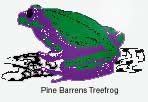 Long pants and boots
are recommended. Bring insect repellant and a flashlight. Persons who are interested in
attending should complete and return the registration form
or call (609) 971-1635 for more information. Long pants and boots
are recommended. Bring insect repellant and a flashlight. Persons who are interested in
attending should complete and return the registration form
or call (609) 971-1635 for more information. |
