Forked River
Mountain |
|
Save the datesField Day...
Forked River
Barnegat Bay
more details in the
|
COALITION RECEIVES TRAILS GRANT
The Forked River Mountain Coalition has been awarded a $15,000 grant by the NJDEP to begin the planning and construction of a trails system in the Forked River Mountain area. While the Coalition will develop a comprehensive plan for a multi-use trails system, only a small portion will actually be constructed at this time.
“Most of the area is still private property,” said Kerry Jennings, President of the Coalition. As we acquire more land for open space, we will construct the various segments of trails and link them together, added Jennings. The Coalition will utilize its own volunteers to help construct and maintain the trails.
The grant will allow the Coalition to investigate and establish an initial multi-use trail that will stand alone as well as become part of the larger trails system in the future. A small interpretive trail is also currently envisioned. The trail will be somewhere in the newly created Forked River Mountain Wildlife Management Area. The property is owned by the New Jersey Conservation Foundation, a Coalition partner.
Eventually, over 20 miles of hiking, interpretive, mountain biking, horseback, cross-country skiing and motor vehicle trails are possible. The purpose of constructing a trails system is to allow people the opportunity to experience this unique area of the Pine Barrens and learn about the areas resources without damaging or degrading them.
Individuals or groups that would like to get involved in the Forked River Mountain trails project should contact the Coalition by calling 609-971-1635 or write to P.O. Box 219, Forked River, NJ 08731.
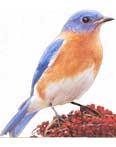
The Coalition’s bluebird nest box trail had fantastic results during its first year. Our nest boxes fledged a total of twelve bluebirds. We are again in need of a few dedicated individuals to help monitor the nest boxes during the second year of the project from March until August. If you would like to volunteer as a bluebird nest box monitor, please call the Coalition at 609-971-1635 no later than March 1, 2000.
|
For the past year, the Forked River Mountain Coalition has been busy working to permanently protect this vast wilderness. Below are just some of our accomplishments for 1999 and some of our future goals for 2000, and beyond . Accomplishments
|
But we can only realize our goals with your help. If you are not currently a member of the Coalition and would like to join, or if you are a member and have not yet renewed your membership, simply complete the registration form. Be sure to mark the appropriate box and return the form along with your $15 membership dues for 2000. Please help support the grass-roots initiative to permanently protect the Forked River Mountains and the vast wilderness that surrounds them.
|
|
Did you know...
|
Critter
Corner. . . 
Timber
Rattlesnake
The timber rattlesnake is one of two venomous snakes in New Jersey and the only venomous snake in the Pine Barrens. Adults range from three to five feet in length. Timber rattlesnakes have broad, arrow-shaped heads, rough, divided or keeled scales, and a rattle on the end of their tails. Their color varies with black or dark brown cross bands and spots on a ground-color of yellow, brown or gray. The tail is always black and the rattle adds segments each time the snake sheds its skin. Some people believe that you can tell the age of a rattlesnake by counting the number of segments on the rattle. Since a rattlesnake can shed more than once a year, this is not true.
Timber rattlesnakes are extremely rare in New Jersey, and in the Pine Barrens. There may be only five or six populations left with more than 50 adults in all of the state. In the Pine Barrens rattlesnakes generally hibernate in shallow underground dens along the edge of streams flowing mainly through Atlantic white cedar swamps. They utilize the flat, sandy uplands surrounding their den sites as their home range for foraging and brooding. Rattlesnakes return to the same den sites each year.
Timber rattlesnakes are not aggressive creatures. Most people who are bitten are trying to kill or capture the snake. Their venom is used to obtain prey. A rattlesnakes diet consists mainly of rodents and other small mammals and birds. The timber rattlesnake is considered an endangered species in New Jersey. This is primarily a result of their indiscriminate killing and habitat loss due to development. Historic accounts of timber rattlesnakes exist in the Forked River Mountain area. We hope to someday rediscover them or reintroduce them into suitable habitat. With your continued support, we will be able to do just that.

