Forked River
Mountain
Views |
Newsletter of the Forked
River Mountain Coalition |
www.frmc.org |
Vol. 9 No.2 |
|
***Just A Reminder***
Forked River Mountain Cleanup
Where: Wells Mills County Park
Route 532
Waretown, NJ
When: Sunday, April 21, 2002
Arrive Between
8:30 am and 9:00 am
Return Between
12:30 pm and 1:00 pm
*Optional Hike Afterwards* For more information or to register
call (609) 971-1635 or sign up here |
Annual Meeting Set
A special
Thank you to the dozens of individuals who recently
joined or renewed their membership with the Coalition. This support will enable the
Coalition to continue our grass-roots initiative so we can all realize our goals of
preserving the Forked River Mountains and the vast wilderness that surrounds them.
Members of the Coalition will be able to participate in the
eighth Annual
Meeting and election of members to the Board of Trustees. The Annual Meeting is scheduled
for May 8, 2002 at 7:00 p.m. at Wells Mills County Park. If you are a member of the
Coalition, you will receive a written notice of the election about a month before the
Annual Meeting.
If you are not currently a member of the Coalition but would like to
join, or if you are a member and have not yet renewed your membership, simply complete the
registration form. Be sure to mark the appropriate box and
return the form along with your $15 membership dues for 2002. Contributions are
tax-deductible.
Join Us in the Great Outdoors. . .
Here are some exciting
opportunities to learn more about the Forked River Mountains
|
Canoe Trip
 The Forked River Mountain Coalition will sponsor our
eighth annual canoe trip down Cedar Creek on May 27, 2002. We will depart
Double Trouble State Park at 10:00 am and return approximately 3:00 pm. The cost is
$10 per
person. There is a three (3) person limit per canoe.
The Forked River Mountain Coalition will sponsor our
eighth annual canoe trip down Cedar Creek on May 27, 2002. We will depart
Double Trouble State Park at 10:00 am and return approximately 3:00 pm. The cost is
$10 per
person. There is a three (3) person limit per canoe.
Bring lunch, drink, insect repellant, sun
tan lotion, hat or sun glasses. Long pants and sneakers are recommended. No alcohol.
We will provide canoes, life
preservers and transportation back to Double Trouble State Park.
Persons who are interested in attending should
complete and return the registration form or call
(609) 693-1268 for more information.
Treefrog Hike
If you would like to try your luck at discovering
an endangered Pine Barrens Treefrog join us on the evening of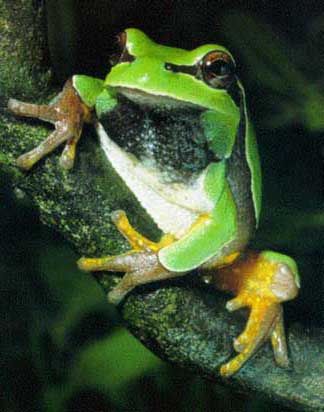 Friday, June
7,
2002. We will
meet at the former Bamber Store at 7:30 pm and return around 9:30 pm. The Bamber Store is
located at the intersection of Lacey Road and Dover Road about 5 ½ miles west of
Garden State Parkway
exit 74. Friday, June
7,
2002. We will
meet at the former Bamber Store at 7:30 pm and return around 9:30 pm. The Bamber Store is
located at the intersection of Lacey Road and Dover Road about 5 ½ miles west of
Garden State Parkway
exit 74.
Click on the frog to hear it's call! There will also be an opportunity to view
several unique plants during the hike including sundews, pitcher plants and the endangered
curly-grass fern.
The cost for this program is only
$5 per person. You must provide your own transportation. Long pants and boots
are recommended. Bring insect repellant and a flashlight. Persons who are interested in
attending should complete and return the registration form
or call (609) 971-1635 for more information.
* Some illustrations from A Field Guide to
the Pine Barrens of New Jersey by Howard Boyd, Plexus
Publishing, Inc. Medford, NJ |
Barnegat Bay Festival
The sixth annual Barnegat Bay Festival will be
held on Saturday, June 8, 2002 at Berkeley Island County Park. The festival is a cooperative effort
of non-profit organizations and government agencies dedicated to maintaining the health and quality of the Barnegat Bay and its
vast watershed covering most of Ocean County. The festival is designed to
heighten environmental awareness about the
natural resources of the watershed and the impact of human activities on
these resources.
maintaining the health and quality of the Barnegat Bay and its
vast watershed covering most of Ocean County. The festival is designed to
heighten environmental awareness about the
natural resources of the watershed and the impact of human activities on
these resources.
Open space conservation in the Pinelands compliments
efforts to protect Barnegat Bay because many of the streams and rivers that flow into the
bay originate in the Pinelands. The Forked River Mountain area contains the headwaters to
three major tributaries of Barnegat Bay, including the Cedar Creek, Forked River and
Oyster Creek. For additional information call
(732) 506-5313.
Whitesbog Blueberry
Festival
The 19th annual Whitesbog
Blueberry Festival will be held on Saturday, June 29, 2002.
The Blueberry Festival commemorates the cultivation of
the blueberry and the birth of the blueberry industry. The festival is held
at Historic Whitesbog Village, located on the outskirts of Browns Mills, NJ
in Lebanon State Forest. The festival provides activities, music, food and
fun for the entire family including guided tours and walks of the area.
The festival is presented by the Whitesbog
Preservation Trust who are working to restore this important piece of New
Jersey heritage. Oh yes and don't forget the blueberries! For more
information call (609) 893-4646.
|
Botanical Bounty . . .
Pine Barrens Bellwort
Description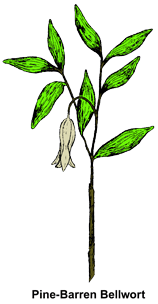
Pine Barren Bellwort is a
perennial herb from a short, stout rhizome with several fleshy fibers. The
smooth stem, 3" - 7" tall, bears several alternate, thin, oval leaves, pointed
at the summit and rounded to a stalkless base. The leaves, bright green and
shining on both sides (but especially beneath), may have faintly rough margins
at maturity and barely noticeable net-veined patterns beneath. The rather large,
terminal, pale to cream-white flowers, 5/8"-1" long, are solitary and
pendant. The stalkless seed capsule is triangular, to 5/8" long.
Flowering Period
Mid-April to early June. Although plants may persist well beyond flowering, they
may be difficult to find because of concealment by competing vegetation.
Habitat
This
little lily grows in moist to wet sand, often at the foot of slopes on the
shrubby edge of a white cedar swamp or an adjacent pitch pine lowland. On
occasion, sterile plants lurk within dense thickets of heath shrubs, waiting for
some sort of disturbance to favor them with more direct sunlight. It also occurs
on the edge of road ruts and shoulders, along ditches of cranberry bogs, and in
old logging trails through marginal wetlands. Plants often associated with it
include pyxie, turkeybeard, sand myrtle, teaberry, black huckleberry, and sheep
laurel.
Range
While
the typical variety, Uvularia Puberula Michx., is quite common in the piedmont
and mountains of the Carolinas and in known from at least nine states, the
variety Nitida appears to be restricted to the Atlantic coastal plain of Long
Island (endangered), New Jersey (imperiled), southeastern Virginia, and
the Carolinas. The lily actually was first collected in Ocean County, NJ in
1889. In New Jersey it is known from the Pine Barrens of Monmouth, Ocean,
Burlington, Atlantic and Camden counties. Here it has always been rare and
local, normally occurring in small populations of just 1 or 2 to 24 plants.
Threats To This Species
Succession by shrubs, traffic of ORVs and timber harvesting trucks, and road
shoulder maintenance such as scraping and untimely mowing have resulted in the
destruction of several populations.
Management Techniques
Coordination with parks, fish and wildlife, and forest personnel is necessary to
prevent the inadvertent destruction of roadside populations via maintenance
practices (esp. scraping, road widening) on state owned land. Strategic
placement of logs could prevent damage to populations by ORVs. Timely cutting
back of shrubs can enhance the survival chances of occurrences threatened by
succession.
Several new populations of this rare and endangered plant have recently been
discovered in the Forked River Mountain area. With your continued support we can
preserve habitat for this and other rare and endangered plant (and animal)
species.
Support the Forked River Mountain Coalition
 |
Click on the shirt to visit our gift shop |
